 |
 |
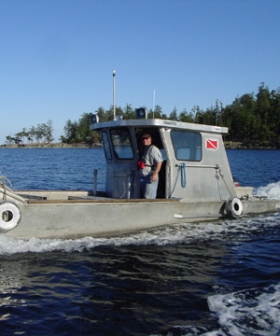 Talk to Wylie, of Access Diving, to be taken to this great scuba dive site. |
|
|
 Alberthead
Lagoon in Metchosin, B.C.
Alberthead
Lagoon in Metchosin, B.C. Bear Cove in Port Hardy, B.C. Bob's Spot in the Plumper Island Group, B.C. Braemar Ave in North Saanich, B.C. Breakwater Island near Gabriola Pass, B.C. Browning Passage near Port Hardy, B.C. Browning Wall near Port Hardy, B.C. China Creek near Port Alberni, B.C. Clover Point in Victoria, B.C. Copper Cliffs near Campbell River, B.C. Daphne Islet near Brentwood Bay Deep Cove near Sidney, B.C. Discovery Island near Victoria, B.C. Dolphin Beach near Nanoose Bay, B.C. Elliot's Beach Park in Ladysmith, B.C. Five Fathom near Port Hardy, B.C. Forest Island (north end) near Sidney, B.C. GB Church [ship to reef] near Sidney, B.C. Gowland Point on South Pender Island, B.C. Henderson Point near Sidney, B.C. Madrona Point in Nanaimo, B.C. Maple Bay near Duncan, B.C. McKenzie Bight near Victoria, B.C. McNeill Point aka Kitty Islet in Victoria, B.C. Neck Point in Nanaimo, B.C. Northeast Pearse Wall, Telegraph Cove, B.C. Ogden Point in Victoria, B.C. Porteau Cove Marine Park, B.C. Port McNeil, B.C. Rocky Point in Nanaimo, B.C. Row & Be Damned near Campbell River, B.C. Saltery Bay near Powell River,B.C. Saxe Point in Esquimalt, B.C. Sidney, B.C. Ten Mile Point in Victoria, B.C. Wall Beach near Nanoose Bay, B.C. Whytecliff Park near Vancouver, B.C. Willis Point near Sidney, B.C. International Kailua-Kona on the Big Island of Hawaii, USA Kaui - an Island of Hawaii, USA Aquatic but Non-Marine Life Vancouver Island, B.C. |
Scuba Diving Pictures from Breakwater
Island near Gabriola Pass, British Columbia.
Canada These are medium quality jpegs. But I have the RAW images as well. Email tjfidler@telus.net Directions to the Dive Site are located at the bottom of the page. Number of dives I've done at this scuba diving site: 2, yes only 2. As this spot is located a couple hours away, and requires paying for a ferry. Type of dive: boat dive Rating for this dive site: 8.5/10 for its abundance of life Parking: N/A Boat ramp: N/A Ease of entry: N/A [Wheel chair access: The Access Diving boat has a "wheel chair" lift to take divers out of the water. ] Abundance of life: 8.5/10 Attractions: Solid rock walls with lots of holes, also lots of holes in the rock near the walls. Bottom and depth: The wall here has spots that are fairly shallow, and deeper parts as well. Between 40 and 80+ feet deep. Facilities: None Hazards/Obstacles: This dive can only be done at certain times within the tide cycle. Due to periods of current. Sensitivity to tide/current: The richness of life here is in part due to the current, but that also means you can only dive here at certain times. Terrain: rock wall structure with lots of crevices, and holes Tides, transportation and weather: Fisheries and Oceans Canada Tide Page., BC Ferries Schedule and Sailings. , The Weather Network
Just clicking on the ads helps pay for the web site. |
The following images are thumbnails. If you click on them a larger image will open up and the picture will take up most of your screen. Again these are medium qualifty jpegs. Higher quality images can be purchased directly from me via paypal using my email address tjfidler@telus.net And many of these photos can be found for sale on Cafepress through the Calendar link and Photo CD link.
A few people have already asked me about "What is that pink stuff on the rocks in some of the pictures?" Well, they're usually Pink Rock Crust (aka Encrusting Coralline Algae) or in some cases might even be Encrusting Hydrocorals. They're eaten by a variety of animals - apparently as a good source of calcium.
Cephalopods, Crustaceans, Fish, Mollusks, Nudibranchs, Sea Anemones, Sea Cucumbers & Echinoderms, Sponges, Tunicates, Worms, Miscellaneous
Crustaceans
 |
 |
| Bering Hermit Crab ~ about 3 inches [7.5 cm] across the shell
is living within. I saw more hermit crabs here than I've ever seen before. Literally hundreds. But mostly young ones. (April 12, 2008) |
Bering Hermit Crabs and a
Widehand Hermit Crab. Looks like the larger of the Bering Hermit Crabs is trying to rob or steal the smaller hermit crabs shell. But it would quickly realize that the shell is too small for it. (April 12, 2008) |
 |
 |
| Widehand Hermit Crab and an
Aeolid [nudibranch] of some kind. This hermit was quite small. Only about two & a 1/2 inches [6.25 cm] along the snail shell length. (April 12, 2008) |
Sharp Nosed Crab ~ 4 inches [10
cm] for the width betweens its elbows. (April 12, 2008) |
 |
 |
| Sharp Nosed Crab (April 12, 2008) | Cancer Crab blocking the hole to its den. (April 12, 2008) |
 |
 |
| Moss Crab ~ about 4 inches [10
cm] long. Note that they are very similar to the Sharp Nosed Crabs, but have smaller arms. (April 12, 2008) |
Moss Crab catching Snail. They
seem to be predators of snails. And I've seen Sharp Nosed Crabs and Hermit Crabs acting as predators as well. (April 12, 2008) |
 |
 |
| A Giant Acorn Barnacle trying to
catch particles of food in its arms. Every barnacle here had sponge, colonial tunicates, fringed filament worms, and/or yellow boring sponge on their shells. Sometimes I wonder if the yellow boring sponge kills the barnacles. (April 12, 2008) |
Giant Acorn Barnacle ~ 6 inches
[15 cm] in diameter. With a Blood Star above it. (April 12, 2008) |
![Golfball Crab [aka Rhinoceros Crab] crustacean - Breakwater Island off of Gabriola Nanaimo - scuba diving site vancouver island british columbia canada](scubadivingpictures_files/breakwaterisland_files/99_jms_GolfBallCrab_90p_P4120098.jpg "Click on here for a larger image") |
 |
| An adult Golf Ball Crab ~ 8
inches [20 cm] wide with the legs. Surrounded by Fringed Worms. These worms are probably the most numerous animal at this site and I've never seen them before at any other place I've dove. (April 12, 2008) |
A juvenile Golf Ball Crab [aka
Rhinoceros Crab] ~ 4 inches [10 cm] including the legs. (April 12, 2008) |
 |
 |
| A Heart Crab being held by a Scuba Diver. (April 12, 2008) | A juvenile Puget Sound King Crab ~ 6 inches [15 cm] across. (April 12, 2008) |
 |
|
| Moss Crab ~ 3 inches [7.5 cm]
across the main shell. Note the various sponges on its carapace. Part of the camouflage of these animals. (Sept 20, 2008) |
Back to top.
Fish
 |
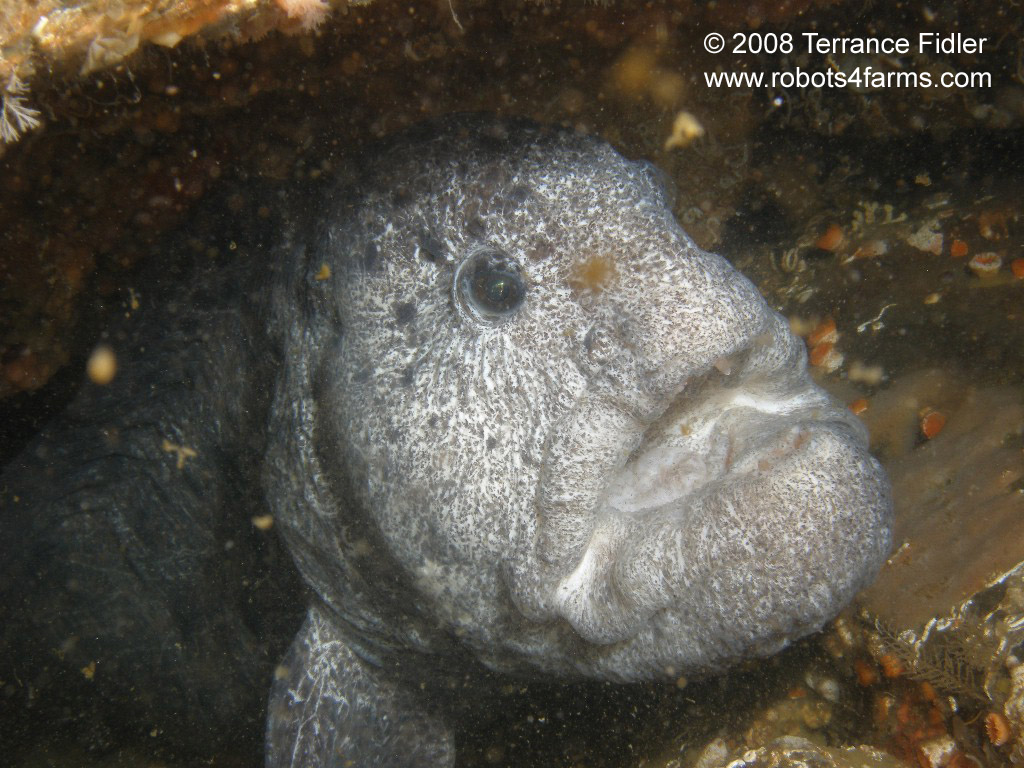 |
| A Wolf Eel [Anarrichthys ocellatus] peering out of its den.
There appears to be three pairs of them here.The seemed a little shy today. Perhaps my bright lights bothered them. (April 12, 2008) |
Wolf Eel [Anarrichthys ocellatus] Wylie coaxed it out of its den. I think it was kind of reluctanct at first because of the lights on my camera. Its head is about 10 inches [25 cm] tall. These are quite large animals. Perhaps 6 feet [2 metres] long. (April 12, 2008) |
 |
 |
| Wolf Eel [Anarrichthys ocellatus] - peeking out of its den. (April 12, 2008) | Longfin Sculpin ~ 4 inches [10
cm], White Soft Coral [?], some Orange Cup Corals and not sure what the mass in the lower left corner is. (April 12, 2008) |
 |
 |
| Grunt Sculpin ~ 4 inches [10 cm] long. (April 12, 2008) | Grunt Sculpin - same animal as
on the left. It was not fleeing from me but seemed to be turning its back to me most of the time. (April 12, 2008) |
 |
 |
| Painted Greenling - using more
natural light. But that was not on purpose. My strobe light failed to trigger a few times during the dives this day. (April 12, 2008) |
Quillback Rockfish ~ about 10 inches [25 cm] long. (April 12, 2008) |
 |
 |
| Painted Greenling ~ 12 inches [30 cm] long. (Sept 20, 2008) | Quillback Rockfish ~ 12 inches
[30 cm] One of the easier fish to take photographs of but they too will eventually swim away. (Sept 20, 2008) |
 |
 |
| Painted Greenling ~ 12 inches [30 cm] long. (Sept 20, 2008) | Scalyhead Sculpin ~ 5 inches [12.5 cm] long. (Sept 20, 2008) |
 |
 |
| Kelp Greenling ~ 2 feet [60 cm]
This is a female. They rarely stay still during the day for me to take a picure of them. At night its a lot easier if you can find them. (Sept 20, 2008) |
Longfin Sculpin ~ 5 inches [12.5
cm] long. Also to the top left there appears to be a baby Decorated Warbonnet or maybe a Mosshead Warbonnet or at least some- kind of gunnel. (Sept 20, 2008) |
|
|
Back to top.
Mollusks
 |
 |
| Geoduck Clam ~ three inches [7.5 cm] across the top. (April 14, 2008) | Abalone ~ 12 inches [30 cm] across. (April 14, 2008) |
 |
 |
| Rock Scallop ~ 12 inches [30 cm]
across. There was several of this at this dive site. (April 12, 2008) |
Rock Scallop ~ 12 inches [30
cm]. Notice the eye spots on this one. (April 12, 2008) |
 |
 |
| Blue Lined Chiton beside a Snail
Shell. The chiton is around two inches long [5 cm]. (April 12, 2008) |
A large limpet ~ 3 inches [7.5
cm] with a baby chiton just left of the center of the shell. Note the one rhinophore protruding on the top left. These animals are like snails but their shell is not spiraled and more like a clam in some ways. (Sept 20, 2008) |
 |
|
| Gumboot Chiton ~ 10 inches [25
cm] (Sept 20, 2008) |
Back to top.
Nudibranchs [or Sea Slugs] & Snails
 |
 |
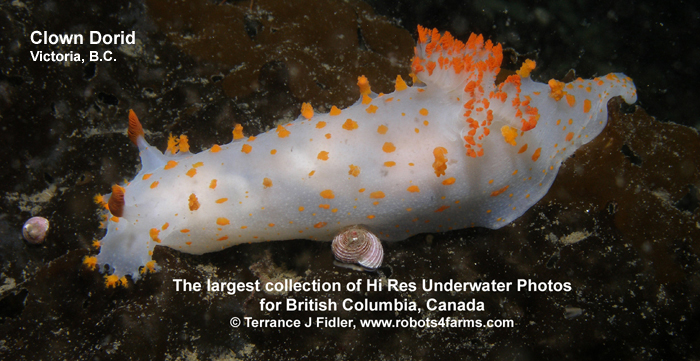
| Clown Dorid [Triopha catalinae] ~ about 3 inches [7.5 cm] long. (April 12, 2008) | Noble Sea Lemon ~ about 10 inches [25 cm] long. (April 12, 2008) |
 |
 |
| Golden Dirona [Dirona aurantia] ~ about 5 inches [12.5 cm] long. (April 12, 2008) | A couple of Heath's Dorids and
a few Orange Cup Corals. The OCC's are normally no more than about inch and a half [4 cm] across. (April 12, 2008) |
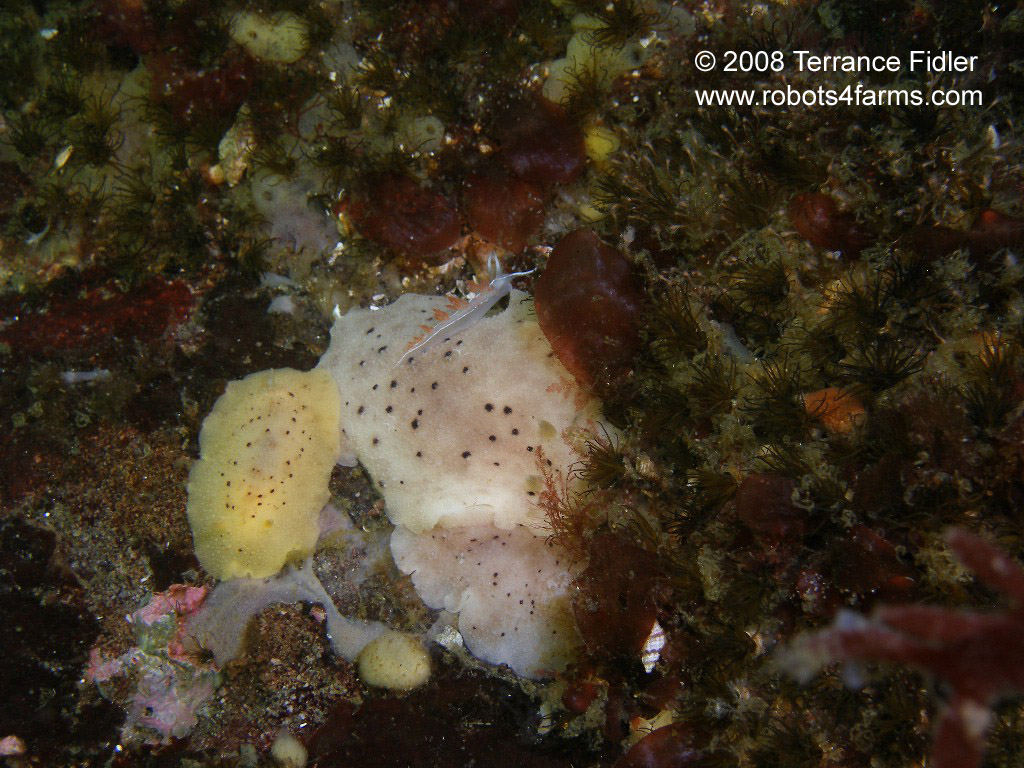 |
 |
| Three Heath's Dorids and a
Three-Lined Aeolid crawling over one of them. (April 12, 2008) |
Hudson's Dorid ~ 2 inches [5 cm] (Sept 20, 2008) |
 |
 |
| Golden Dirona [Dirona aurantia] ~ 3 inches [7.5 cm] long. (Sept 20, 2008) | Golden Diroan [Dirona aurantia] ~ 4 inches [10 cm] (Sept 20, 2008) |
 |
|
| Noble Sea Lemon ~ 10 inches [25 cm] (Sept 20, 2008) |
Back to top.
Sea Anemones ( Cnidarians )
 |
 |
| Zoanthids surrounding a Giant Acorn Barnacle. Also some
Yellow Boring Sponge on the shell of the Barnacle. Note the small hermit crab near the top. (April 12, 2008) |
Painted Anemone ~ 10 inches [25 cm] across. (April 12, 2008) |
 |
|
| Short Plumose Anemones hanging
from one of the many rock over hangs along the main wall here. (April 12, 2008) |
Back to top.
Sea Cucumbers & Starfish ( Echinoderms )
 |
 |
| Two Orange Sea Cucumbers
protruding out of holes in the solid rock. Along with a Pale Sea Cucumber to the left of them. (April 12, 2008) |
Something you don't see very
often. An Orange Sea Cucumber crawling around. Normally you only see them sticking their tentacles out and feeding. (April 12, 2008) |
 |
 |
| This Pale Sea Cucumber is
feeding. They catch food with their tentacles and then place their entire arm into their "mouth." (April 12, 2008) |
Brown Sea Cucumber ~ 10 inches [25 cm] showing. (April 12, 2008) |
 |
 |
| Blood Star ~ 8 inches [20 cm] across. (April 12, 2008) | Leather Star ~ 10 inches [25 cm] across. (April 12, 2008) |
 |
 |
| Morning Star ~ about two feet [60 cm] across. (April 12, 2008) | Morning Star ~ about two feet
[60 cm] across. Crawling along the edge of the main rock wall here at Breakwater Island. (April 12, 2008) |
 |
|
| An adult Sunflower Star ~ almost three feet [1 metre] across. (April 12, 2008) | A juvenile Sunflower Star ~ two
feet [60 cm] across. These smaller ones are more often this brighter orange colour. (April 12, 2008) |
 |
 |
| Mottled Star ~ two feet [60 cm] across. (April 12, 2008) | A slightly mutant Purple Star -
not the extra arm tip on the arm pointing to the left. (April 12, 2008) |
 |
 |
| Painted Star ~ two feet [60 cm] across. (April 12, 2008) | Painted Star ~ two feet [60 cm]
across. Note the small hermit crab on top of it. (April 12, 2008) |
 |
 |
| Red Sea Urchin ~ about 10 inches [25 cm] across. (April 12, 2008) | Vermilion Star ~ 8 inches [20 cm] across. (April 12, 2008) |
 |
 |
| Striped Sun Star ~ over two feet [60 cm] across. (April 12, 2008) | A Spiny Pink Star ~ almost three
feet [1 metre] across. Note the large number of snail shells near it. (April 12, 2008) |
 |
|
| Leather Star ~ 14 inches [35 cm] wide. (Sept 20, 2008) |
Back to top.
Sponges
 |
 |
| Yellow Boring Sponge on what
appears to be an old shell of a Rock Scallop. The diameter of the yellow area is about 1 foot [30 cm]. (April 12, 2008) |
Giant Acorn Barnacle covered in
sponge. And a sponge beside it. The sponge on the right is about 10 inches [25 cm] in diameter. (April 12, 2008) |
 |
 |
| A mixture of sponges. (April 12, 2008) | Sponge of some kind. (April 12, 2008) |
 |
 |
| Velvety Red Sponge surrounded by Orange Cup Corals. (April 12, 2008) | Orange Finger Sponge ~ 10 inches
[25 cm] wide. |
Back to top.
Tunicates
Back to top.
Worms
 |
 |
| Northern Feather Star - using natural light. (April 12, 2008) | Northern Feather Star - using a strobe light. (April 12, 2008) |
 |
|
| Fringed Filament Worms - the
most abundant or dominant life form at this dive site. (April 12, 2008) |
Back to top.
Miscellaneous
 |
|
| Pink Encrusting Hydrocoral. (April 12, 2008) |
Back to top.
If you want to locate this site on a map, or print out a map, you can user either:
Google Maps: Insert directions here
Or
MapQuest: Insert directions here